

Story and photos by JOYCELYNE FADOJUTIMI
From Transactional Space to Experiential Hub: How institutional capital and “place-making” are converting a legacy shopping center into an economic engine for East Texas.

Physical retail is staging a powerful comeback, and the Longview Mall is positioned to be a primary benefactor of this macroeconomic shift.
At a recent Chamber “State of the Economy” event, Tommy Miller, Managing Director and Chief Investment Officer of Trademark Property Company, laid out a bullish thesis for the sector, detailing how the firm’s recent acquisition of the local asset will serve as a catalyst for regional economic growth.


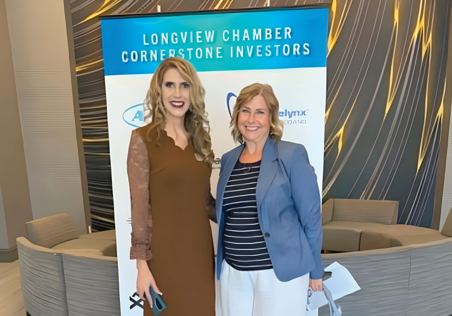
City manager MaryAnn Hagenbucher.
Introduced by Kelly Overby, General Manager of the Longview Mall, Miller brought over three decades of commercial real estate expertise to the podium. His firm, Trademark, is a leading mixed-use developer with a 34-year track record spanning 58 properties. They currently manage 18 premier assets, including the Galleria in Dallas and Rice Village in Houston.
TRADEMARK PROPERTY COMPANY BY THE NUMBERS


The Macro Shift: A Cyclical Upswing for Brick-and-Mortar
The retail landscape has fundamentally shifted from the post-2008 doldrums. For nearly two decades, fears over e-commerce dominance led to severe institutional underinvestment in enclosed shopping centers. However, a post-COVID paradigm shift has inverted this trend.
According to Miller, retailers have realized that pure-play e-commerce models cannot sustain long-term profitability. Physical stores are now recognized as essential infrastructure for “last-mile” services, including local delivery, buy-online-pickup-in-store (BOPIS), and seamless returns.


Simultaneously, a consumer “revolt” has driven shoppers back to physical environments. Decades of minimal new construction have created an acute supply-demand imbalance, resulting in:
- Historic low vacancy rates
- Accelerating rental rate growth
- Strong year-over-year sales volume expansion
With major metropolitan areas facing limited retail vacancies, institutional capital is pivoting toward secondary markets, making cities like Longview a magnet for new investment.

Stabilization Strategy: Rebuilding the Longview Asset
Trademark acquired the Longview Mall under the thesis that it was a fundamentally strong asset that had been historically “under-invested and under-managed.” The firm is executing an immediate capital expenditure program to stabilize the property and restore tenant confidence.
CAPITAL IMPROVEMENT TIMELINE
┌───────────────────────────────┐
│ PHASE 1: PROPERTY ACTIONS │ -> Roof, Parking, Lighting, Paint, Landscaping
└───────────────┬───────────────┘
▼
┌───────────────────────────────┐
│ PHASE 2: LAUNCH (AUG/SEPT) │ -> New Children’s Play Area and Rebranding Signage
└───────────────┬───────────────┘
▼
┌───────────────────────────────┐
│ PHASE 3: TENANT ACTIVATION │ -> Dillard’s Men’s Store Opening
└───────────────────────────────┘
The repositioning has already secured significant institutional validation. Dillard’s co-invested in the mall acquisition and purchased an additional footprint to launch a dedicated men’s store.
Furthermore, Trademark confirmed that its leasing team has secured several “first-to-market” retailers, alongside an unannounced major retail anchor slated to occupy a portion of the former Sears anchor space.
The Playbook: “Place-making” and Community Value
Trademark’s investment thesis relies heavily on “Place-making”—a strategic approach that transforms properties from transactional shopping centers into experiential community hubs. The firm leverages public art, custom furniture, murals, and curated events to drive dwell time and increase consumer asset productivity.
Miller presented several institutional case studies demonstrating the efficacy of this strategy:
- Dallas Galleria : Under Trademark’s stewardship, sales doubled in eight years following structural overhauls, enhanced green spaces, and the integration of experiential concepts like the Netflix House.
- La Palmera Mall (Corpus Christi): Acquired in 2008 as the struggling Padre Staples Mall, Trademark redeveloped the asset “inside out,” re-engineered the food court, and introduced premier tenants, successfully revitalizing the city’s broader retail ecosystem.
- The Woodlands (North Houston): Developed into a high-density, mixed-use town center that functions as a central park infrastructure surrounded by dining and public gathering spaces.
- Rice Village (Houston): Modernized with public art installations—such as its signature astronaut mural—to lower the average consumer demographic age and attract high-end, institutional tenants.

Regional Outlook: Mitigating Capital Leakage
For the Longview business community, the revitalization of the mall extends far beyond real estate metrics. High-quality retail infrastructure is a critical benchmark for corporate site selectors. When new enterprises evaluate expanding or relocating to Longview, the availability of strong retail, housing, and quality-of-life amenities directly dictates their ability to recruit executive talent.
Crucially, a modernized Longview Mall serves as an economic firewall. By bringing highly sought-after, first-to-market brands to the city, the development prevents consumer spending “leakage” to larger neighboring metropolitan areas.
With institutional capital returning to the sector, Trademark’s revitalization strategy aims to transform the Longview Mall into a regional destination, boosting the municipal tax base and driving long-term economic vitality for East Texas.